Wednesday, February 4, 2015

Everlasting Play Dough


I jokingly call this the play dough that just won't die. Because it won't. If keep in an air tight container or zip top bag, this dough will last for months without refrigeration. I only throw it away because its gotten gross from so much play. It is super simple to make and change up to meet your child's play needs. 

Recipe:
4 cups flour (I use bleached because it takes color better in my opinion)

1 cup salt
4 tbsp cream of tartar (mine are usually slightly rounded)
1/3 cup vegetable oil
3 cups boiling water

I use to make play dough by hand. Then one day on a whim I tried our stand mixer. The heavens opened, angels sang, and I've never looked back. 

Add all the dry ingredients to the bowl and give it a little stir.
Add the oil and another quick stir. 
Pour in the boiling water and mix until a dough ball forms. 

Put the dough ball on a slightly floured surface and knead until smooth. 

That's it! I know, who knew the world's greatest play dough was so simple. 

Here's some tips and tricks I've learned along the way:


  • Use boiling water! Hot tap water will not work. 
  • Add food coloring or a kool aid packet to the boiling water BEFORE adding to dry ingredients. This will help evenly distribute the color. 
  • You need a good amount of food coloring. You shouldn't be able to see through the water. Gel or liquid food coloring work well. 
  • Essential oils or spices can be added to the dry mix before pouring in the water
  • Only use the superfine powdery glitter, the bigger stuff falls out while playing with the dough
Trouble Shooting:
  • If your play dough is sticky, sprinkle with flour then knead through adding more until it is smooth
  • If it feels dry or is cracking, drizzle with oil and knead well
  • If left out, wet your hands with water and knead through to revive. 


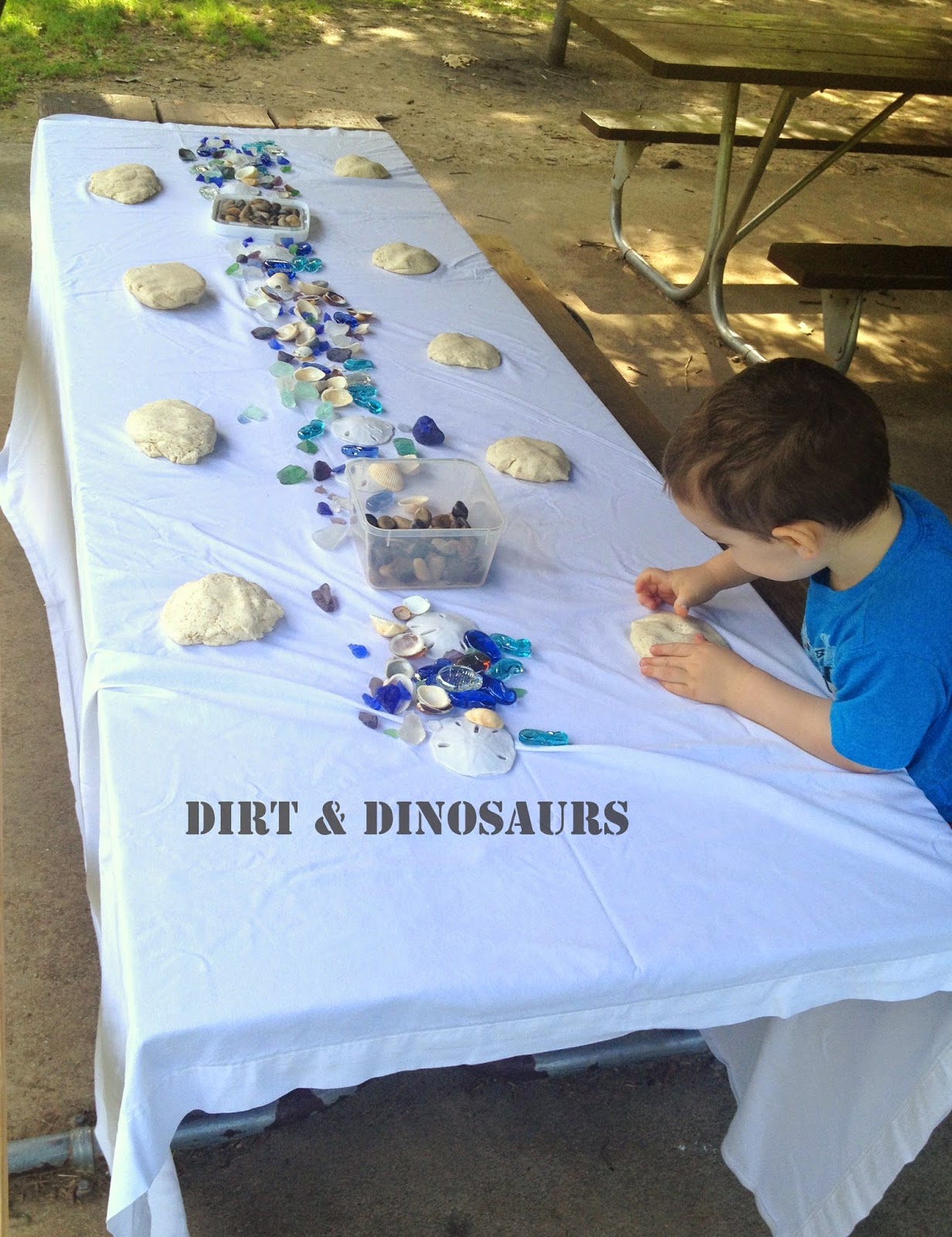
We've done all sorts of varieties with this base recipe. One of our favorites was beach play dough for a play date at the park. I kneaded in some sand from the craft store, then supplied the kids with beach glass, seashells, smooth rocks, and decorative glass beads. 


We continued to play with this play dough for months after our park play date. MONTHS.


Another favorite with our outdoor art group was ABC play dough. For this I used packets of frosting creations and kool aid to scent and color, I added some extra food coloring to give it a boost. We had pink bubble gum, blue cotton candy, and purple grape. It smelled AMAZING and the colors swirled together beautifully. 


We had alphabet dough stamps from Lakeshore Learning, letter cookie cutters, and foamy letters from a dollar store puzzle. Baby Rex got a set of alphabet rubber stamps for his birthday which also work really well with play dough.


 Other favorites have included Turkey play dough. Scented with pumpkin pie spice with feathers.

Red cinnamon scented play dough with heart cookie cutters, foamy spots, and black pipe cleaners to make love bugs.

Blue or white peppermint scented dough with jewels and snowflake cookie cutters for Frozen inspired play.

Strawberry frosting creations with pink glitter. Beads and jewels for princess play dough. 

Black lavender scented with silver sparkles for space dough. 

The possibilities are endless! So get out your mixer and have some fun!


Friday, November 7, 2014

Homeschool Preschool

I have been getting lots of questions lately about our homeschool preschool curriculum. The best thing I can tell you is this- you do NOT need to purchase a curriculum to teach your child.

Children, especially preschoolers, learn best from their environment and everyday activities. We play to learn everyday all day. By providing your child with meaningful play to learn opportunities, interacting with them through play or real life experiences, and allowing them to explore the natural world, you are teaching your child. 

Daily we use everyday toys and activities to make real world connections with academic basics. We also use tons of art projects to explore literature, science, and build a foundation for later learning. Duplos are great for teaching colors, counting, sorting sizes, patterns, and more. ABC puzzles, magnets, and play dough stamps introduce early literacy concepts. 


We are also heavily into sensory play. These provide easy ways to create meaningful play to learn activities that support scientific or academic concepts.  Feel free to take a look at my posts on sensory play 101 and why I love sensory play for more information.

The syllabus we use is very basic and easy to follow. I just made a spreadsheet in excel to keep us on track and for planning. We have 1-2 week theme based units with an ‘of the week’ focus. The themes are usually seasonal or holiday based plus a letter, number, shape, and color of the week. I use books with story stretcher activities to explore themes in depth. We use hands on activities and art projects to teach academics. Weekly letter art is a big favorite at our house.  Our ABC boxes get a lot of use too. Math manipulatives, DIY or store bought, make math practice easy.

The most important thing is for your child to have fun. Preschool age is all about instilling a love of learning and fostering their natural curiosity. Use what your child is interested in and go from there. Personally I am not concerned with when my child master’s his ABC’s or 123’s. When he can spell his name or write independently. I do not stress over pushing academics, he will get there when he’s ready. 


And lastly we read. A lot. It is one of the few times Baby Rex will sit still for any length of time. We read together for 30-60 minutes every night before bed, plus other times during the day. He is also really into board games and puzzles which are great teaching extensions. 

Please let me know if you have any questions about anything. Have fun and happy homeschooling!

Date & Theme Letter Num. Shape Color Science & Social Studies
September
8  Community Helpers M 6 Circle Purple Comm Helpers
15  Community Helpers B 9 Triangle White Fire Safety
22  Apples A 3 Square Red Apples
29  Apples Z 7 Star Green Johnny Appleseed
October
6  Forrest Friends D 5 Oval Brown Forest Animals
13  Forrest Friends Y 2 Rectangle Blue Nocturnal Animals
20  Pumpkins I 8 Heart Orange Pumpkins
27  Pumpkins O 10 Diamond Black Pumpkin Dissection
November
3  Fall & Leaves 4 Circle Yellow Fall
10  Fall & Leaves P 1 Triangle Pink Leaves
17  Thanksgiving  & Food E 3 Square Brown Food Groups
24  Thanksgiving & Food N 5 Oval Orange 1st Thanksgiving
December
1 Christmas & Nativity J 9 Rectangle White Nativity Story
8  Christmas & Nativity C 2 Diamond Green Nativity Story
15 Christmas & Nativity U 7 Star Red Nativity Story
22   Break/Review
29  Break/Review
January
5  Snow & Ice I 4 Square White Cold/Hot
12  Artic Animals R 8 Circle Blue Artic
19  Transportation G 6 Triangle Purple Wheels & Ramps
26  Transportation F 10 Rectangle Brown Sink/Float
February
2 Valentines/Friends Q 1 Heart Red Character Dev
9  Valentines/Friends V 13 Heart Pink Character Dev
16 Space S 15 Star Yellow Planets
23 Shadows X 18 Oval Black Shadows
March
2  Dr. Suess T 12 Rectangle Blue Mixing Colors
9  Noah's Ark & Rainbows H 20 Circle multi Noah's Story
16  St. Patrick's Day W 16 Shamrock Green Folk Tales
23  Easter K 19 Triangle Orange Easter Story
30  Easter A 14 Oval White Easter Story
April
6  Farm Animals P 17 Square Pink Farm Animals
13  Farm Animals D 11 Diamond Red Visit Farm
20  Weather O 15 Rectangle Blue Weather Words
27  Weather R 19 Circle Yellow Weather Experiments
May
4  Flowers/Seeds S 13 Triangle Purple Plant Parts
11  Flowers/Seeds E 16 Heart Orange Plant Growth
18   Caterpillars/Butterflies B 18 Square Green Butterfly Life Cycle
25   Caterpillars/Butterflies A 20 Circle Pink Butterfly Life Cycle

Wednesday, February 12, 2014

Valentine's Tubby Time

I wanted to do something special on Valentine's Day for Baby Rex. We've been playing with conversation hearts, making crafts, and all things heart themed all week. It was time to just be silly and have some fun.
I painted the tub with washable paint while Baby Rex was napping. I used a heart shape cookie cutter to stamp the hearts on, it was an easy and fast way to decorate. By the time he woke up everything was dry and ready to go. I made jello hearts following the jigglers recipe on the box using the same heart cookie cutter to make the shapes. Next I added his heart shaped measuring scoops and a bag of conversation hearts. He is super excited to play.

  The jello hearts made for an interesting texture to squish with his hands and toes.
Since Baby Rex is only 16 months old I kept all his play material edible just to be on the safe side. As always the rule is 'no mouth' and he is really good about keeping things out of his mouth since we've always done lots of different sensory play. 


The conversation hearts were a great addition that provided many teachable moments. 
We identified and sorted colors and practiced counting. He really liked it when I stacked a few up for him to knock down again and again. 

 This is my FAVORITE picture from today. One of the reasons I love sensory play so much is the goofy grins, silly faces, and endless giggles on my son's face. These are the moments I cherish. 


 As Baby Rex was winding down, I turned on the water to add a new dimension to his play. 
The jello hearts quickly melted while the conversation hearts took a bit longer to dissolve. Baby Rex enjoyed splashing, scooping, and pouring the red cherry scented water.
When he was done playing I just turned on the shower to give Baby Rex and the tub a good rinse.Now we are all set for our next tubby time adventure.


Simple Valentine's Sensory Bin

Happy Valentine's Day

Baby Rex is at an age where he doesn't really understand most holidays. But that doesn't stop us from having a little fun. This Valentine's themed sensory bin was just the thing to brighten up a cold February afternoon. 
Baby Rex and Little Bear enjoyed exploring the contents:
red & white rice
conversation hearts
heart scoops
foam hearts
heart bracelets


Little Bear is a bit more timid than Baby Rex with new materials and textures. I love that he watched Baby Rex interact with the sensory bin before deciding to play himself. Another great example of how sensory play will meet each child where they are and engage them accordingly. Sensory play is an amazing activity for side by side and early cooperative play. 


These two tots really enjoyed their Valentine's surprise sensory bin. They happily explored and played with little input from me. 


I love how sensory play really highlights each of their personalities. Baby Rex is about the big actions and noises- he like to scoop & dump the rice, rain down handfuls, sit in the bin, and trow rice about. 
Little Bear is much more meticulous and detailed orientated. He was the first to notice that the conversation hearts had words printed on them. He inspected each element of the sensory bin in great detail.


Hope you find a special and fun way to celebrate Valentine's Day with your little ones

Monday, February 3, 2014

Sensory Play 101


What is sensory play?
          Sensory play may also be referred to as “messy play” or “hands on learning”. It is anything that engages your child’s senses, most often touch or smell. Babies, toddlers, and preschoolers interact with their world mainly through touch to gain knowledge and feel confident in their environment. At the earliest stages of learning, children process information through direct interaction, observation, and exploration.

What is purpose of sensory play?
Children are hard wired to learn through sensory input from day one. By providing frequent opportunities for sensory play you are helping their brain build neural pathways that will support later learning. At its core, sensory play is the earliest form of the scientific process your child will encounter. They have formulated a question, hypothesized an outcome, experimented, and made conclusions all without being able to verbally communicate it to you.

Sensory play promotes and supports fine and gross motor skills, cognitive development, social interactions, builds self esteem, pre math concepts, problem solving and reasoning skills, imaginative play, language development, and so much more. In a single activity, sensory play can be hugely beneficial to your child crossing multiple early learning objectives. The same sensory play materials can be used with various age children meeting each child where he or she is in the learning process.  Consequently each child will explore, learn, investigate, and form conclusions appropriate to their individual needs.

Creating sensory play opportunities
          Sensory play is a process driven activity. It is about your child’s interactions and explorations with the materials rather than a final product or outcome. Sensory play should be a child lead activity start to finish.  There is NO right or wrong way for sensory play. It can be as simple as rice or beans in a bin to explore or in depth small world play and themed set ups. It can be extremely messy with shaving cream, goop, or Jell-o to no mess at all with sensory bottles, textured fabrics, or glow sticks. Going for a walk to observe nature is sensory play in a simplistic form that requires no set up or clean up and is free.

          As I present the activity or materials to my child, I let him take the lead. I may verbally illustrate what he is doing or feeling. I copy his movements and ideas (within reason!) I may demonstrate a different way to play or ask questions to further the activity. I often pick a few new vocabulary words or phrases to repeat frequently throughout the activity.  This has been a critical learning step for my speech delayed toddler. We verbally label everything!
Example:
Wrapping paper runway- encourage them to run, walk, crawl like a cat, jump like a frog, bear crawl, etc. We’ve now incorporated different movements with animals and sounds.

Set up
Where, when, and how you include sensory play into your child’s daily routine is up to you. Keep in mind your space restrictions as well as you and your child’s comfort level with play materials. Sand/water tables are great inside and out. Under the bed storage containers, baby pools, and my personal favorite – the bath tub, are all great options for containing messes. You may also want to use a sheet, plastic table cloth, or shower curtain to aid in the clean up process. Play materials such as rice, small beans, oatmeal, and lentils all vacuum up easily and quickly for inside play. Get your children involved in the clean up process. My tot loves to use a washcloth to clean the shower walls or the vacuum hose to get the last beans from the play room floor.


Sensory play extensions
          Sensory play can be used to introduce or reinforce other learning concepts and objectives such as color or letter recognition, cultural celebrations, animal habitats, and other areas of scientific study. A favorite at our house is extending a favorite story with a sensory play activity.

Examples:
·       Letter I-Spy: ABC beads in a water bottle with rice
·       Color themed sensory bins, bottles or tub play
·       Holiday themed sensory bins or tub play
·       Ice and arctic animals
·       Mixing colored vinegar with baking soda
·       Mixing paint or colored water


Sensory Play for Babies & Toddlers
          With a little careful consideration and preparation, the littlest of children can participate in sensory play. If you think, many baby toys are in fact geared towards sensory stimulation. Bright or contrasting colors, various textures, toys that crinkle, rattle, or squeak.
I am a huge fan of edible materials for babies and young toddlers. This allows them to freely explore while ensuring their safety. Baby food, yogurt, cooked pasta, oatmeal flakes, bread crumbs, rice, cornmeal or flour – plain or mixed with oil to make moldable dough.
For my son, the more sensory play we did the better he became at keeping things out of his mouth as even with edible materials our sensory play rule is always “no mouth”.

Material Suggestions
          Most sensory play items can be purchased at the grocery store or Target. You can find great accessories or add ins at the dollar store, craft store, or thrift shops.

Food Items: Beans, lentils, pasta, rice, cous cous, oatmeal, cornmeal, flour, bread crumbs, cereal, jell-o, pudding, yogurt, baby food, cooked spaghetti, coffee grounds, popcorn kernels, popcorn, salt, sugar/sugar cubes, coconut, whole nuts (walnuts, pecans, peanuts) dried fruit slices (orange, lemon, apple) Apple peels, marshmallows, sprinkles,
·       root veggies with the leafy tops (carrots, beets, radish)
·       Investigate, then cut open fresh fruit or veggie – bell peppers, squash, watermelon, apples, pumpkins, etc.

Paper: wrapping paper, tissue paper, toilet paper, shredded paper, butcher paper, streamers, Easter grass

Natural Items: acorns, pinecones, grass, leaves, rocks/gravel, dirt, hay, fresh or dried flowers, planting seeds, vegetation - (ferns, moss, grasses), sea shells, drift wood, natural sand, snow, water, ice,

Fabric: Ribbon, felt, tulle, various fabric scraps, yarn

Misc: packing peanuts, bird seed, deer corn, aquarium gravel, glass decorator beads, Epsom salts, shaving cream, glow sticks, paint, pom poms, pipe cleaners, feathers, bubble wrap, cotton balls,

Accessories & Add ins:
Food coloring, essential oils or extracts for scents, kool-aid (to dye and scent), spoons, kitchen utensils, measuring scoops and spoons, funnels, colander, cups, tweezers/tongs, turkey baster, eye droppers, small garden tools, muffin tins, pie plates, tin cups, ice cube trays, small animals or figures, foam shapes, glitter, confetti

What you put into sensory play and get out of it is completely up to you; from super messy, to dry and clean, and everywhere in between. Sensory play provides opportunities to learn, grow, and create magical childhood memories.